"What's a Good Photograph?"
Wing Young Huie’s artistic sensibility keeps evolving, after a half-century of shooting.

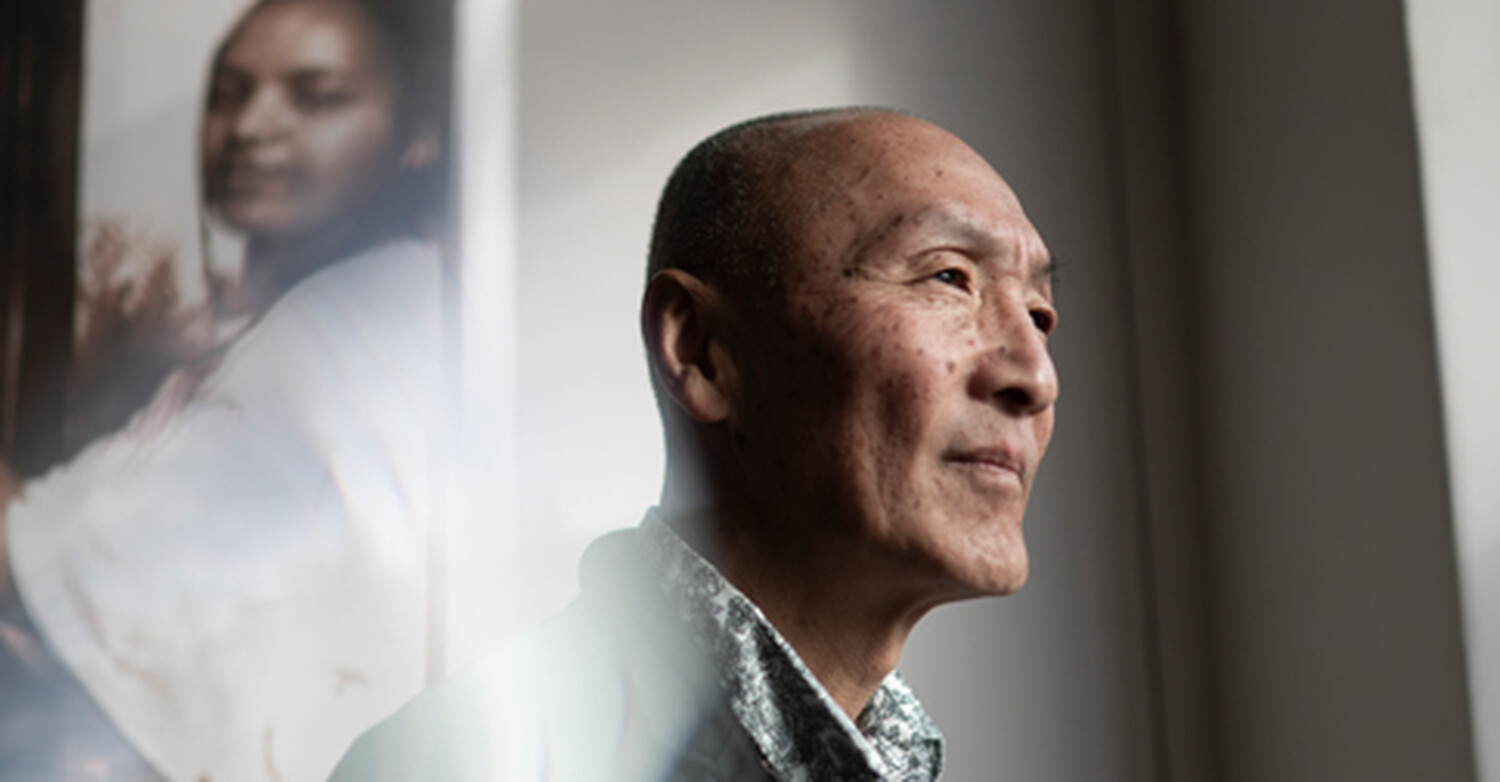
Wing Young Huie hesitates to estimate the number of photographs he’s taken in a career that’s spanned some 50 years. More than a million, he figures.
He’s printed thousands—images included in his many exhibitions. But that leaves a majority stored in flat files at his south Minneapolis studio. And while he has plenty of inspiration for fresh projects, this backlog is top of mind as the celebrated photographer enters his seventh decade.
“At this point in my life, and for a while now, my main goal is to get what I’ve already done out into the world, rather than creating new work,” says Huie (B.A. ’79). To that end, Huie last year teamed up with the Minnesota Historical Society (MNHS), which has contracted to acquire 5,000 photographs from the artist over a five-year period.
A street photographer who’s consistently explored questions of meaning, identity, and culture, Huie now finds himself plumbing new dimensions in his oeuvre. “When I was photographing, I was thinking, ‘What’s a good photograph? What is art?’” he says. “I’ve answered that question in many ways throughout my career, and my work has evolved. Now, going through the archive, I’m thinking about not so much the artistic value—the composition, the motion—but about historical value.”
An angel with a camera
Huie took some of the first of these million photographs shortly after earning his degree in journalism, when he signed up for a workshop with Garry Winogrand, a defining figure in postwar American street photography. Huie was inspired.
But while Winogrand and many artists of his generation aimed for a candid, anonymous interaction with subjects, Huie took the opposite approach.
“I thought it’s better for me to introduce myself,” he says. “And I started thinking about how the interaction with the people I photographed was maybe as important, if not more important, than the resulting photographs.”

Huie often tries to capture these interactions with accompanying written texts. In one series, he even photographed his subjects holding a chalkboard inscribed with a significant phrase or sentence.
His exhibitions have likewise embodied a collaborative approach between artist and subject: Frogtown: Portrait of a Neighborhood (1995), Lake Street USA (2000), and The University Avenue Project (2010) were displayed in public—in vacant lots and storefront windows in the very neighborhoods documented.
Huie is fascinated by questions of individuality, culture, and identity: what he calls a sociological approach. He traces this interest, in part, to his lived experience of growing up a first-generation Chinese American in Duluth, which he explores directly in the words and images of his 2018 book, Chinese-ness: The Meanings of Identity and the Nature of Belonging.
Yet by design, his work typically poses more questions than it answers. “I’m an observer,” Huie says. He likens himself to the invisible angel in Wim Wenders 1987 movie Wings of Desire. “He walked up to people, got in their faces to witness the human drama, people in love, people fighting, people alone. I remember thinking, it would be nice to be that angel. I realized you don’t need to be invisible. Just have a camera around your neck.”
Collective memory
The Minnesota Historical Society (MNHS) was an early champion of Huie’s work; the organization awarded him a research grant in 1993, at the dawn of his career, and maintained the relationship, publishing several monographs based on his exhibitions. (Among later honors, Huie was awarded a UMN College of Liberal Arts Alumni of Notable Achievement award in 2005, and the McKnight Foundation Distinguished Artist award of 2018.) So it’s fitting that MNHS would serve as repository of Huie’s archive.
In addition to prints and scans of photographs, the archive will contain letters, interview notes, and other ephemera as context for the artworks, says Jennifer Huebscher, curator of photography & moving images at MNHS. Huebscher notes that Huie’s archive is distinct from others in the history center’s research collection.
“These images document people and places that are not necessarily notable Minnesotans you would see in a who’s who. It’s more everyday,” she says. “Having images like that really helps give folks a sense of what that time period was like.”
With that framework, as he pores over old contact sheets and negatives, Huie is seeing his work through new eyes. Photos that didn’t make the final cut for an exhibition suddenly make sense in this new context.
Still, like so much of Huie’s work, the proof is in the personal. “There are so many thoughts and emotions that are evoked as I time-travel through this looking glass of 50 years’ worth of work,” he says. “I’m seeing not just the tens of thousands of people that I photographed, but also different versions of myself.
“I’m constantly running into people that I photographed, and sometimes those encounters get a bit emotional as they reminisce. It’s just so wonderful that this archive will be accessible for all those people and their memories.”
If you liked this story, Minnesota Alumni magazine publishes four times a year highlighting U of M alumni and University activities. Early access to stories and a print subscription are benefits of being an Alumni Association member. Join here to receive a printed copy at home.