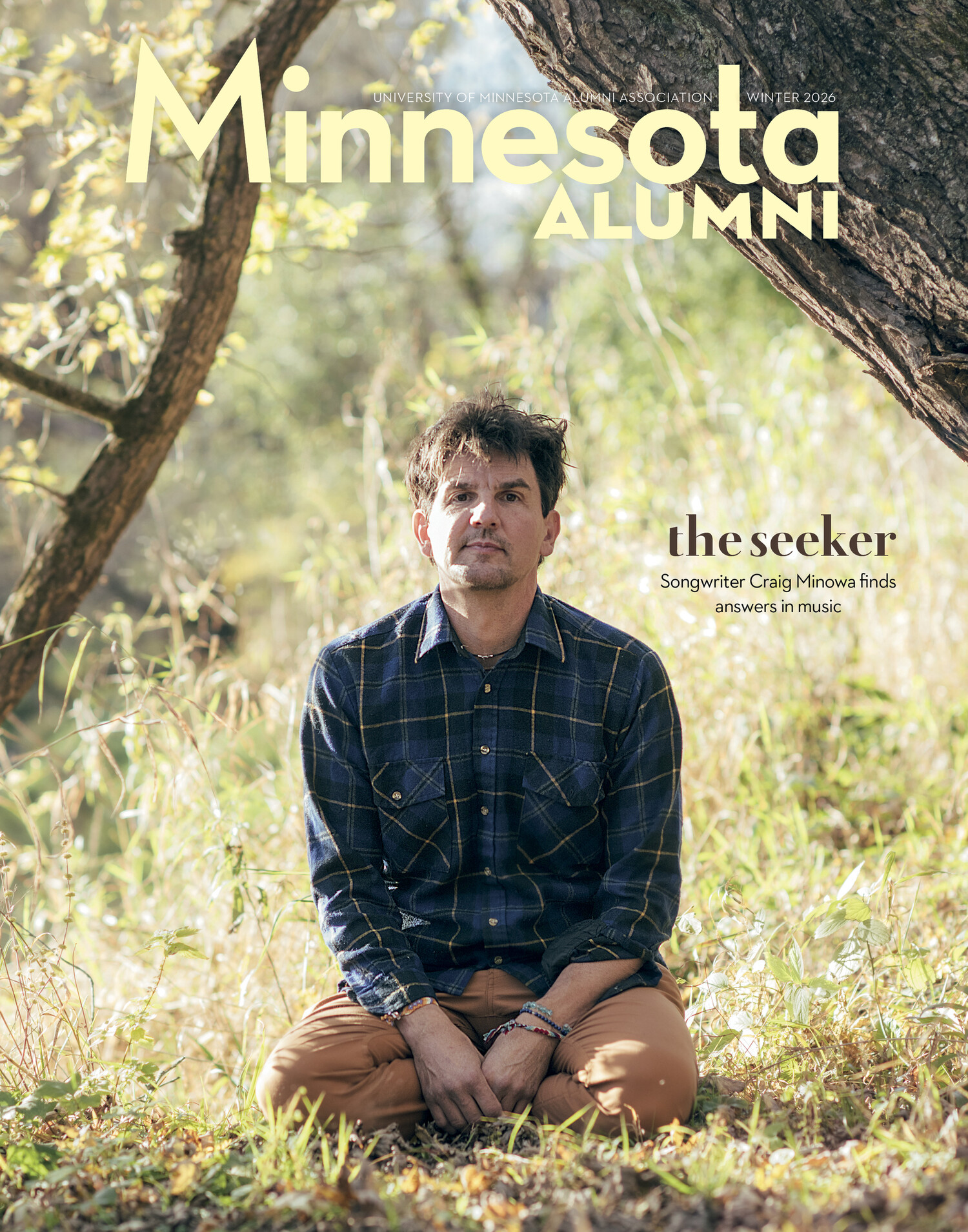
The Seeker
Songwriter Craig Minowa considers music to be medicine.

Everything's under construction at Craig Minowa’s new home and recording studio in Wisconsin’s rural Driftless Region.
Minowa (B.S. ’97), who majored in environmental studies at the University, is the frontman and songwriter for Cloud Cult, a “self-help indie chamber rock band” he formed in 1995. This fall, he wrapped up a run of sold-out shows supporting the band’s latest release, Alchemy Creek—which he wrote and recorded, while processing a painful divorce, in a tiny, temporary studio on wheels, parked next to a spring-fed rivulet not far away. It is the band’s twelfth album.
Now, he’s traded the sound of the creek for the swish of passing cars on a highway that runs a little too close to his new digs.
“Being on that creek, I could hear that water coming, and watch it go, and this feeling of surrender was always there,” says Minowa, whose songs are deeply informed by his background in ecology. “I’m trying to translate that same river feeling to this highway.”
His studio-to-be (which neighbors previously dubbed “the crack shack” for allegedly nefarious traffic) came with used needles, mountains of garbage—and one true treasure: a century-old upright piano with a soundboard constructed from an 800-year-old Sitka Spruce. Today, it holds pride of place amid the construction zone.
“I’m trying to dial in the tone of this piano,” he says. “I’ll come in here when I’m needing medicine and just lean on it.”
Medicinal music
Initially, Cloud Cult was a personal project. After leaving the University, he worked for various advocacy groups, because music “felt like a selfish pursuit.”
As a door-to-door canvasser, he came up against the limits of persuasion on the merits of facts. “I would be at the door, and I’d be like blah, blah, blah,” he remembers. “It was just blank faces. But with the music, people could be changed instantly if you bring their emotions fully into it. I realized I can use music to move people in a way that can bring positive change.”
For Minowa, collective change begins with personal growth. He frequently refers to his songwriting as “medicine.” Music has always brought connection to the divine and healing, he says—an urgent need for Minowa after his and his then-wife and bandmate’s 2-year-old died mysteriously in his sleep in 2002.
Minowa’s writing process begins with meditation and “a mantra to try and get myself out of the way and be of service to something bigger,” he says. His ideal creative state is the hypnogogic space between sleep and arousal: “Your conscious brain is there, and your subconscious is fully there. That’s the spot,” he explains.
His recordings are real-time captures of this dream-world. His work evolved from solo projects under the name Cloud Cult to an expanded sound that incorporated outside musicians for a live show. Along the way, the band earned indie-rock acclaim for its lush, orchestral arrangements and raw, earnest lyrics.
Praise from outlets like Pitchfork and Rolling Stone, as well as strong showings on indie charts, broadened the band’s audience. Recent albums have included elaborate staging and ambitious side projects: the album The Seeker spun off as a one-hour movie starring Josh Radnor and Alex McKenna in 2016; a later collaboration included backing from the Minnesota Orchestra for a run of sold-out concerts.
“As the albums went on and the touring got heavier, there was always the thought of, ‘How are we going to pull this off on stage?’” he explains. Alchemy Creek, released last year, was a return to his earlier process. “It was a spot in life where I needed the medicine really, really bad. So it was like: Don’t think about what anybody’s going to think.”
A new community
The economic realities of the music industry, especially since the pandemic, put additional pressure on Minowa to simplify his approach. Even while his songs gained more audience, streaming services eroded profits and made large-scale productions like The Seeker unsustainable.
“I was stepping out of this as my career, like, music’s just not going to pay the bills,” he says, when a friend encouraged him to check out Patreon—a subscription-based platform that gives fans exclusive access to the works of artists, musicians, and writers.
For Minowa, his roughly 1,500 Patreon members not only pay the bills, but also serve as a community collected around his deeper curative goals. “It opens up a whole new level to the mission,” he says.
A reluctant performer, Minowa says his stage persona has often felt like a necessary burden. It’s after the show, when he meets face to face with his fans, that he really comes alive. “You talk to people and hear their stories. It would lift my spirits and my hope for humanity. Patreon creates that conversation all the time. There are supporters that I know better than some of my best friends now.”
Today, as he sits at his new-to-him piano and starts the meditative process of creating new works, his Patreon supporters are right there with him, sharing his current musical obsessions, which are perhaps even more minimalist than the spare songs on Alchemy Creek.
“I’m just trying to have my supporters listen to the spaces between the chords to hear overtones and resonances and see if they can understand the feeling of non-notes,” he says. “The space in between the notes, that really opens things up.”
If you liked this story, Minnesota Alumni magazine publishes four times a year highlighting U of M alumni and University activities. Early access to stories and a print subscription are benefits of being an Alumni Association member. Join here to receive a printed copy at home.