The Passivist
Rolf Jacobson of the University’s Center for Sustainable Building Research wants you to know about passive houses.
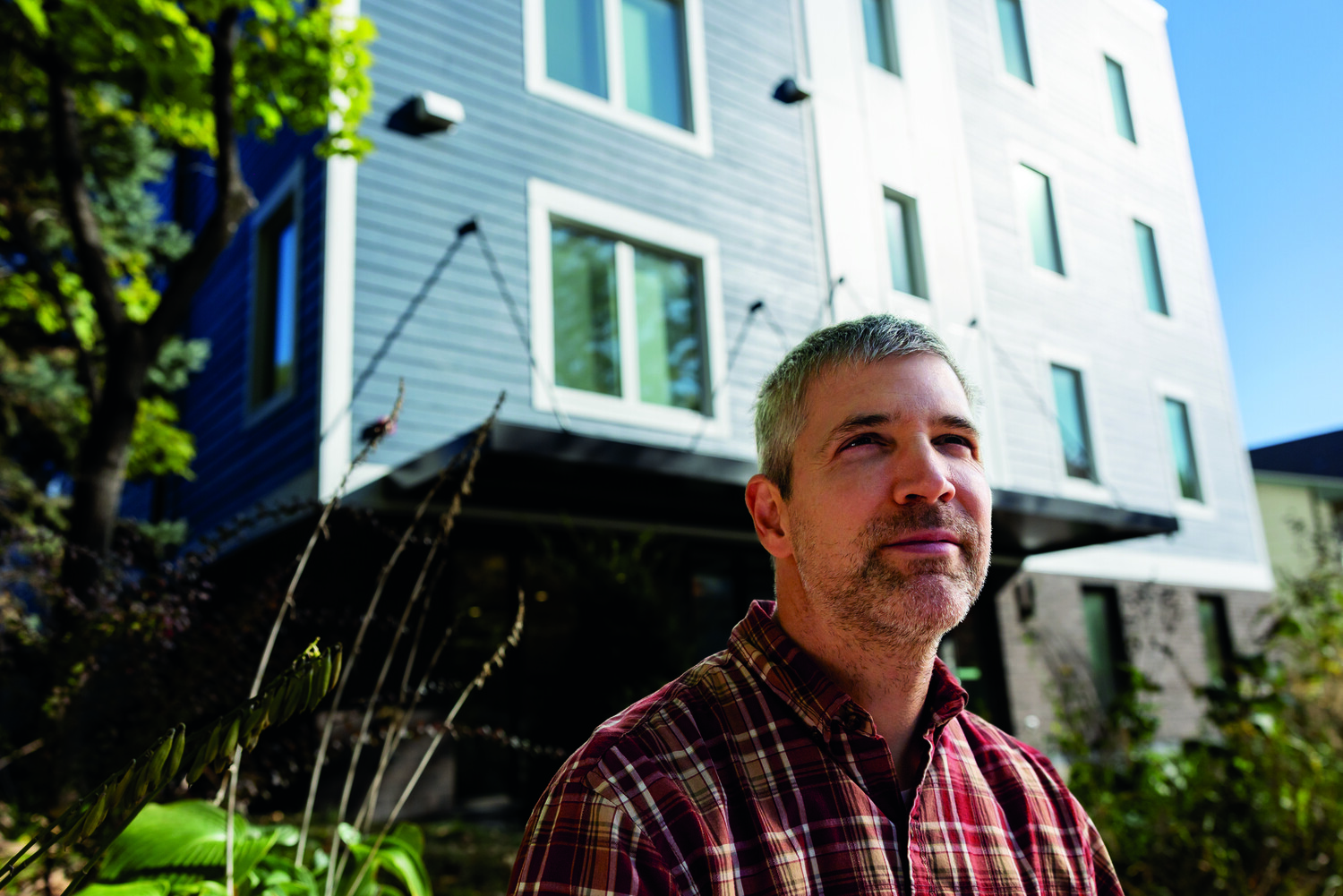
As a graduate student studying architecture at the University of Minnesota, Rolf Jacobson (M.Arch. ’08) stumbled upon a presentation that would change his life. Swiss-born local architect Stephan Tanner was speaking to a group of students about a structure he’d designed and built called a “passive house.”
“I just kind of wandered in and when I saw his presentation I was really taken aback,” Jacobson says. “He had pictures of people on the construction site installing the foundation, with foam blocks of insulation up to their waists. Nobody had carried energy efficiency to that kind of maximum extent, and it looked absolutely ridiculous.”
Tanner’s building was the Waldsee BioHaus, constructed in 2006 as the first structure in North America to meet the rigid certification standards of Germany’s Passivhaus Institute. Essentially, passive houses take energy efficiency to extreme levels, using methods like super-insulation to heat and cool buildings instead of relying on mechanical HVAC systems.
For Jacobson, the die was cast. “After that presentation from Stephan Tanner,” he says, “I realized that was what I was going to do in the building industry.”
Prior to receiving his master’s degree in 2008, Jacobson launched his own company, Skandia Design & Consulting. But it was the University of Minnesota that really launched his career in 2010, awarding him a Fulbright Scholarship to study passive houses for a year at the Norwegian University of Science and Technology in Trondheim.
“It was that trip that gave me the skills that I rely on in my professional career,” he says. “What I do now is what I was learning while I was over there.”
Today, Jacobson is a research fellow at the University of Minnesota’s Center for Sustainable Building Research (CSBR), and his interest in passive houses has never wavered. He’s now a certified passive house consultant (from the Passive House Institute U.S., or Phius), and a recognized local authority on the subject. He has seen the Twin Cities residential market increase from a handful of units to hundreds—primarily in the form of several multifamily apartment projects.
Meanwhile, the Washington Post reported in late 2024 that the nation “may be on the cusp of a passive house boom, driven by lowered costs, state-level energy code changes and a general greater awareness of—and desire for—more sustainable housing.” So, as awareness of passive houses grows, Jacobson has grown accustomed to answering the basic question: What, exactly, is a passive house?
“Everyone knows the food pyramid,” he says. “The base is your grains and your protein, and then your fruits and vegetables, and above that your desserts are on top. For a lot of people, when they think about buildings and sustainability, the first thing in their mind might be solar panels—‘I’ll just put solar panels on my house.’ But that’s really the dessert on top. It’s really the last thing you want to do. The base of that pyramid is making it efficient in the first place. And that’s what passive houses are focused on.”
Further explanations entail what he calls “a lot of boring stuff,” like the grains at the base of the food pyramid. “It’s the additional insulation, the caulk to seal the air gaps. It’s thinking about stuff like ‘Can I have more windows on the south side than the north side?’ or ‘Can I orient my house to the south?’ Slapping on solar panels is the exciting, fun part. But when you do that and you haven’t taken care of the pyramid’s base, you put yourself in a bad position.”
Jacobson believes passive houses have a strong future in the construction industry, that energy codes will require stronger minimum standards to reduce energy consumption. He believes that people will learn that passive houses offer intangible benefits, like quiet, alongside tangible ones like cleaner indoor air.
As a research fellow at CSBR, Jacobson says that only a small slice of his work is directly related to passive houses, but the knowledge he picked up in Norway is broadly relevant. “A lot of the work we do at CSBR is oriented toward sustainability, but I think my background gives me a wedge of knowledge that is not shared by many of my coworkers at CSBR,” he says. “It’s given me my own wheelhouse, which is kind of cool.”
Back when he walked out of Tanner’s presentation some 20 years ago, Jacobson realized he wanted that niche. And he recommends that current students try to find one of their own.
“What I realized was the more you can guide your own education, the better off you are. I realized ‘This is what I want to learn; this is what I want to know.’ If you can specialize, you become so much more interesting and valuable to employers. That’s the biggest lesson I learned.”
Dick Dahl is a freelance writer in the Twin Cities.
If you liked this story, Minnesota Alumni magazine publishes four times a year highlighting U of M alumni and University activities. Early access to stories and a print subscription are benefits of being an Alumni Association member. Join here to receive a printed copy at home.