Discoveries
Hope for spinal cord injury recovery; AI-powered aerial robots fight wildfires; Advancing treatment for AML; A new method for producing iron and steel
Hope for spinal cord injury recovery
A research team at the University of Minnesota has demonstrated a new process that combines 3D printing, stem cell biology, and lab grown tissues for spinal cord injury recovery.
According to the National Spinal Cord Injury Statistical Center, more than 300,000 people in the United States suffer from spinal cord injuries, yet there's no way to completely reverse the damage and paralysis from the injury. A major challenge is the death of nerve cells and the inability for nerve fibers to regrow across the injury site. The team’s research addresses this problem.
The method involves a groundbreaking 3D-printed framework for lab-grown organs, called an organoid scaffold, with microscopic channels. These channels are populated with regionally specific spinal neural progenitor cells, which are cells derived from human adult stem cells that have the capacity to divide and differentiate into specific types of mature cells.
The researchers transplanted these scaffolds into rats with spinal cords that were completely severed. The cells differentiated into neurons and extended their nerve fibers in both directions—rostral (toward the head) and caudal (toward the tail)—to form new connections with the host’s existing nerve circuits.
The new nerve cells integrated seamlessly into the host spinal cord tissue over time, leading to significant functional recovery in the rats.
The study was published in Advanced Healthcare Materials.
AI-powered aerial robots fight wildfires
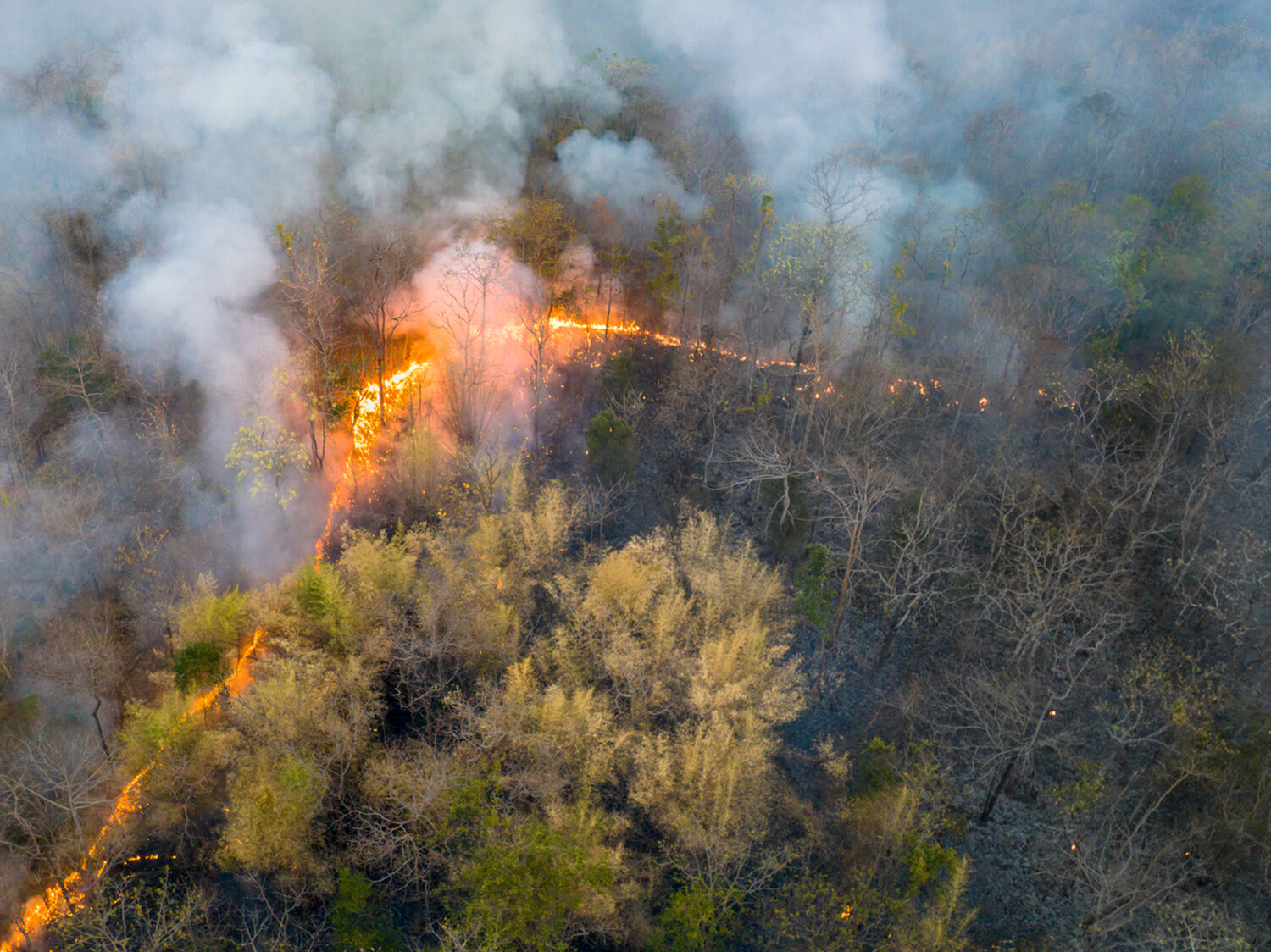
In a significant advance for wildfire management, researchers at the University have developed AI-powered aerial robots capable of tracking and mapping smoke plumes in real time, offering the potential to revolutionize air quality predictions and hazard responses. This approach promises to revolutionize the understanding of smoke dynamics and improve air quality predictions, offering a potential new tool in the fight against wildfires.
Traditional methods of tracking smoke plumes, such as satellite imaging, often lack the resolution needed for precise data collection. The drones are equipped with advanced sensors and artificial intelligence, enabling them to fly directly into smoke plumes and gather detailed data. By building three-dimensional reconstructions of plumes, the drones provide insights into how smoke particles move and disperse over long distances.
From 2012 to 2021, prescribed burns in the United States led to 43 wildfires, emphasizing the need for better smoke management tools. Previous modeling systems struggled with data accuracy and field observations, leaving gaps in the understanding of fire and smoke behavior. The U of M team’s coordinated system addresses these deficiencies by tracking plumes in real-time and producing comprehensive flow pattern analyses.
The study was published in Sustainability Times.
Advancing treatment for AML
Masonic Cancer Center researchers are making progress in their search to find better treatments foracute myeloid leukemia. Acute myeloid leukemia, or AML, is a rare form of blood cancer—one that becomes even deadlier if the disease has a mutation of the TP53 gene. People whose disease does not have the TP53 mutation can be cured; those whose disease has the mutation usually die in a year.
Zohar Sachs, M.D., assistant professor of medicine, and her research team have illuminated how the TP53 genetic mutation leads to more severe cases of AML—and how doctors might be able to disrupt the disease’s progression.
After studying AML cells in the lab, Sachs and her colleagues realized that a specific molecular pathway associated with the TP53 mutation essentially neutralized treatment and allowed the disease to progress unabated. They believe that if they can halt that pathway by adding a new drug, then the standard AML therapy might become far more effective.
The team plans to explore its hypothesis through a clinical trial led by Joseph Norton, D.O., assistant professor at the medical school. The trial is fueled by support from the Randy Shaver Cancer Research and Community Fund and conducted in partnership with M Health Fairview and the Masonic Cancer Center, University of Minnesota.
This study was published by the University of Minnesota Foundation.
A new method for producing iron and steel
Researchers at the University of Minnesota, working in partnership with Hummingbird Scientific, have shown how hydrogen plasmas that are not thermal can form fleeting but highly energetic hydrogen radicals—atoms so reactive that they can smelt iron ore at room temperature.
Until recently, no one had seen what these reactions looked like on the tiniest scales. Other experiments employed bulk samples that masked the fine details within disordered structures. To get around this problem, researchers developed a new device called operando plasma transmission electron microscopy, or TEM. This instrument can image magnetite nanoparticles directly upon exposure to hydrogen plasma at a resolution of around one nanometer. That’s 10 times better than earlier optical methods and allows researchers to watch the process in real-time.
In 10 seconds of exposure, magnetite particles began shrinking and developing cracks. Hydrogen radicals were stripping oxygen from the crystal structure, leaving metallic iron behind.
The particles followed a shrinking-core model, where the reaction began on the surface and propagated inward, dissolving away the oxide. That meant that the reaction rate was governed by surface chemical steps rather than by transport across the particle. Scaling up is good news, as it suggests the focus should be put on controlling plasma radical density rather than worrying about diffusion through large chunks of ore. This could open new possibilities for catalysis, fabrication of nanomaterials, and energy storage.
This study was published in Nature Communications.
If you liked this story, Minnesota Alumni magazine publishes four times a year highlighting U of M alumni and University activities. Early access to stories and a print subscription are benefits of being an Alumni Association member. Join here to receive a printed copy at home.