Up Front
Study Halls; Esther's Legacy; Charmed, They're Sure; The U's Sports Law Team Conquers Mardi Gras
Study Halls
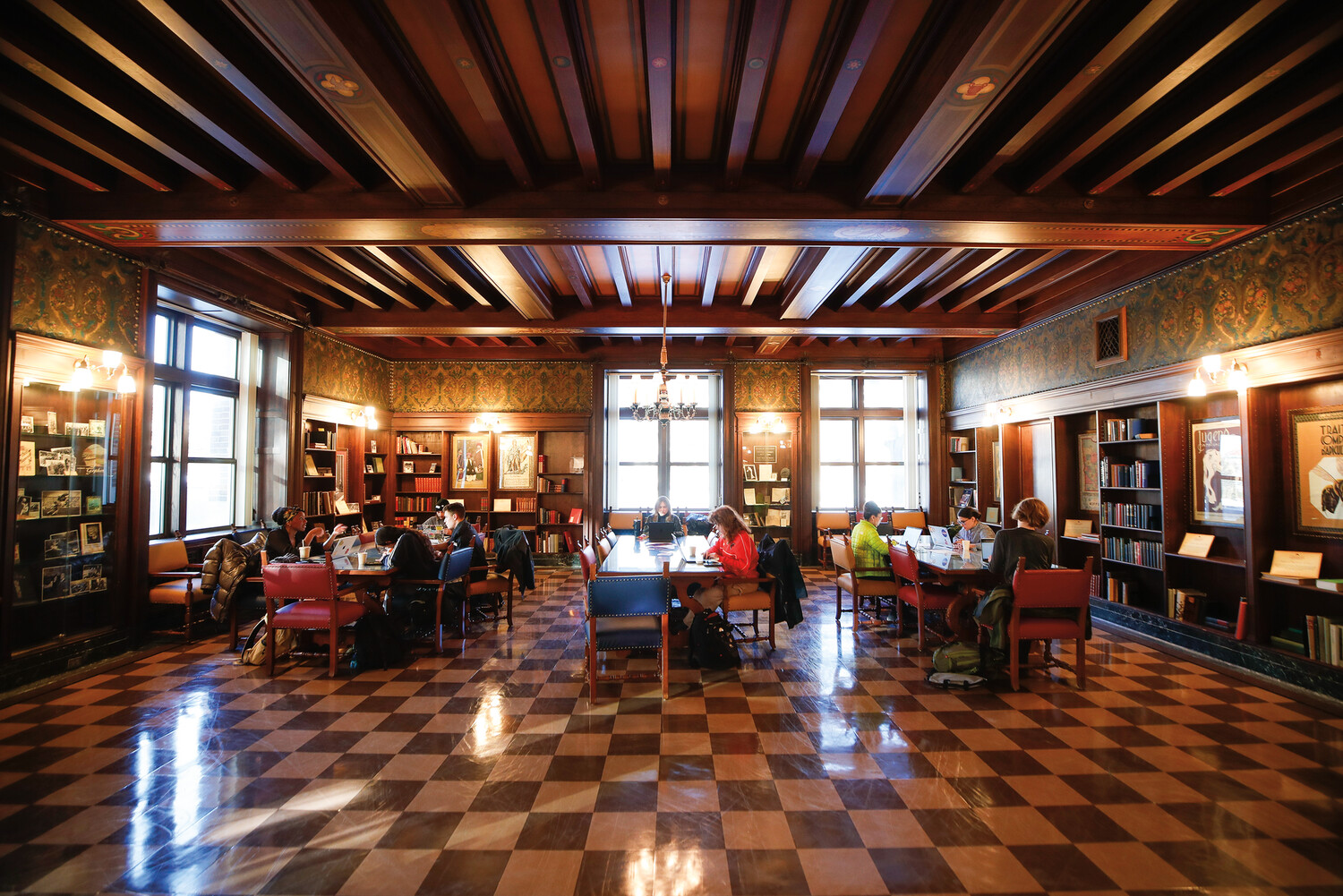
We asked about your favorite places to study on campus. Here’s what three alumni had to say.
My favorite place to study was the 24-hour computer lab in Lind Hall in the late 1990s and early 2000s. I also enjoyed studying at Walter Library on the East Bank and Wilson Library on the West Bank. I would try studying on Northrop Mall but would get distracted :-). Ski U Mah.
Hoang Uyen Nguyen (B.A. ’02)
I was a physics undergraduate in the Institute of Technology from 1974 to 1978. My freshman year I lived in Territorial Hall, which at that time was an all-male dorm. My roommate and the rest of the dorm floor residents were not nearly as interested in studying as I was, so I was ecstatic to discover the Bio-Medical Library in nearby Diehl Hall. I spent many blissful evenings in the quiet of that library studying until it closed at 10 p.m.
Michael Wade (B.S. ’78)
I really liked Pillsbury Hall. I liked scurrying up to the Winchell Library to study in between classes. The sound of creaking wooden stairs, the acidic-like smell of chemical tests done in the rock labs, the unique but comforting “stuffiness” in the air. It was another home outside of my dorm room in Pioneer Hall.
Randall Wehler (B.A. ’70)

Esther's Legacy
If you heard about Esther Freier’s career at the U, you might have questions about the lecture series that bears her name, a series this year celebrating its 25th anniversary.
A chemist and professor of medical technology, Freier was known for coauthoring the first paper dealing with quality control in clinical chemistry and for serving as the first woman president of the Academy of Clinical and Laboratory Physicians and Scientists. When she retired in 1991 after 45 years at the U, she held the only endowed chair in medical technology in the nation.
Freier also loved stories.
“She had bookcases filled with books, everything you can imagine. Plays, essays, birding magazines, science magazines,” says Sara Zuk (B.A. ’68), Freier’s niece. “Her abilities were in the sciences, but she loved reading and theater.”
When Freier passed away in 1997, she left behind a gift: The Esther Freier Lectures in Literature Endowment, which allows the Department of English to present public readings twice a year by prizewinning authors. Writers also visit with undergraduate and graduate students.

“Esther felt that the humanities were underfunded and underappreciated. Her goal was to bring in writers from allover the world to give the humanities attention,” Zuk says.
Since the start of the series, Zuk has served on the English committee that selects incoming writers. Even after more than 50 authors, Zuk still remembers the first. “Jamaica Kincaid came in 2001. She had just written a novel about her brother passing away. I remember feeling a strong kinship with her, though our lives are very different,” she says.
In 25 years, the series has featured U.S. Poet Laureates and Pulitzer Prize-winning novelists, children’s lit authors, environmentalists, a doctor, a cartoonist, and the immigrant poet and novelist Ocean Vuong, who packed Coffman’s Great Hall last fall. There are so many stories.
“Junot Díaz wins the award for the most f-bombs dropped,” says Terri Sutton, the Freier Series events coordinator. “Student overflow led to 50 to 75 people sitting in the aisles, which we got in trouble for later.”
Fiction writer T.C. Boyle described hosing down wildfires around his California home before leaving for Minneapolis. Indigenous high school students drove up from Iowa to hear from poets Joy Harjo and Layli Long Soldier. Anna Deavere Smith gave a one-woman show where she played multiple characters. Denis Johnson joked about Train Dreams being a book so short, his friends read it.
“I think the most memorable aspect of these lectures has been the interaction between the visiting writers and the audience,” says Regents Professor Julie Schumacher, who has moderated several Freiers. “To bridge the gap between admiring a writer’s words and being able to speak to that living writer face-to-face—it’s a powerful thing.”
Zuk hopes the Freier events continue to invite the community into the University, as well as into the humanities. “Being in the room with these writers helps you feel a sense of community and connection.”
On September 22, the series presents Booker Prize winner and MacArthur “Genius” George Saunders at Northrop. Professor Schumacher will moderate.
“I so admire Saunders—as a writer, a teacher, and a person,” Schumacher says. “I can’t think of a better choice for a 25th anniversary Freier visitor.”

Charmed, They're Sure
For a long time, college students and alcohol just seemed to go together, almost as a rite of passage. Think Animal House. But that scene never appealed to Della Daml (B.S.B. ’24) and Josephine Miller (B.S.B. ’26). So they decided to create their own adult beverage, one designed to keep the fun and the memories and lose the intoxication. Less for the bar crowd, more for the barre crowd.
Daml and Miller are the cofounders of Charm Social Tonic, a nonalcoholic beverage with unique health attributes that just hit Twin Cities shelves. They met in an entrepreneurship class in the Carlson School of Management.
“We know a lot of people who want to fit in at social situations without drinking alcohol,” says Daml.
Miller finds this not just a noble goal but a health imperative for many of her Gen Z brethren.
“We grew up on screens, which leads to isolation,” says Miller. “Spending time with others is critical to good health. Loneliness carries risks that [are] comparable to smoking 15 cigarettes a day and can carry the risk of premature death by 26 percent. We want to help people connect with others.”
They understand their market. According to a recent Gallup poll, the number of adults 35 or under who say they drink has decreased from 72 percent to 62 percent in the past two decades.
Their entrepreneurship story has a Jobs-Wozniak feel in that Daml and Miller have complementary skills and understand their roles. “Josie is more of the visionary, and I’m more the operations person,” says Daml.
They figured that out early. They also agreed on the ingredients, which they selected themselves, after some trial and error.
“We use 100 percent real natural fruit extracts and fruit juices,” says Miller. And adaptogens, which are natural, nontoxic herbs, roots, and mushrooms.

The first Charm flavor is lemon-ginger, and includes schisandra, lion’s mane, L-theanine, and lemon balm. The recipe has been designed to taste great and improve mood and energy. Charm’s pithy mission statement: “For the nights you want to remember.”
Their inspiration received early validation when they won the student division in the 2025 MN Cup, the state’s largest start-up competition. The duo walked away with $25,000 in prize money.
Daml and Miller manufactured a testing round of 1,000 cans, which they gave away in exchange for feedback. The first flavor is now for sale in the Twin Cities and through online ordering.
So far so good.
“It doesn’t feel like work because we’re having fun,” says Miller.
The University of Minnesota has ranked among the top four universities in startup creation for four consecutive years.

The U’s Sports Law Team Conquers Mardi Gras
The law school's Sports Law Competition Team won Tulane University’s Mardi Gras Sports Law Invitational for the second time in three years. The Invitational is an appellate advocacy competition focusing on presentation of legal arguments concerning the sports industry. The team of Lindsey Thompson (’27) and Ronni Farid (’26) took first place. Thompson was named best oralist, and Farid won third-best oralist in the competition. The team of Evan Bracewell (’26) and Ellie Nagel-Bennett (’26) advanced to the quarterfinals, winning the second-best brief. The team was coached by Carter Allen (’25), Christopher Pham, Aalok Sharma (’13), and Tarun Sharma (’22).
If you liked these stories, Minnesota Alumni magazine publishes four times a year highlighting U of M alumni and University activities. Early access to stories and a print subscription are benefits of being an Alumni Association member. Join here to receive a printed copy at home.